


Contenido
- A journey into the past at Cau d’en Borràs
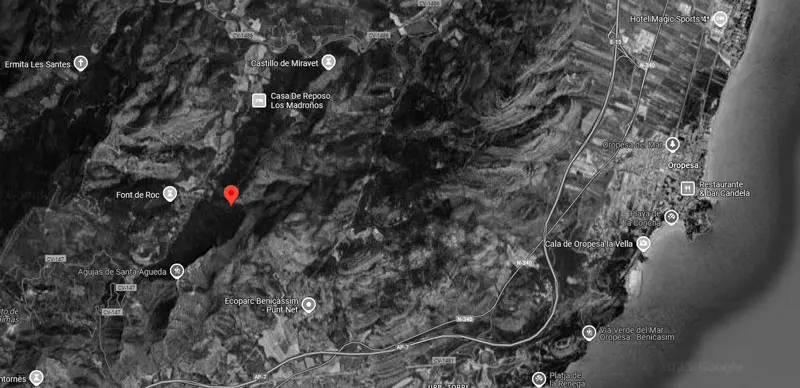
- Where is Cau d’en Borràs? Location and natural features
- Who discovered the site? The story of Vicente Borràs
- This is what the rock shelter-chasm looks like: a prehistoric hideaway inOropesa del Mar
- Life hundreds of thousands of years ago: animal and human remains
- The archaeologists’ work: what was found and how it was studied
- Curiosities from Cau d’en Borràs: surprising finds
- The significance of Cau d’en Borràs in Spain’s prehistoric history
- How can you visit Oropesa del Mar and discover its incredible heritage?
- References and acknowledgements
A journey into the past at Cau d’en Borràs
When we think ofOropesa del Mar, its beaches, its medieval castle or its lively seafront promenade probably spring to mind.
However, hidden amongst the nearby mountains, there is a much older and more fascinating spot: the Cau d’en Borràs, a prehistoric site that takes us back hundreds of thousands of years, to a time when the first humans and numerous wild animals inhabited these lands.
Cau d’en Borràs is not just a cave; it is a true testament to the distant past.
Here, archaeologists and palaeontologists have unearthed unique remains that tell the story of the earliest human settlements in the Mediterranean region of the Iberian Peninsula.
Thanks to the efforts of researchers such as Eudald Carbonell, Jordi Estévez and Francesc Gusi, and the initial discovery made by Vicente Borràs, we can now learn what life was like during the Middle Pleistocene.
This article will take you on a journey to discover all the secrets of Cau d’en Borràs: its location, its incredible fossil fauna, the stone tools created by our ancestors, and the fascinating process of excavation and study.
Get ready for a journey to a past so distant it’s hard to imagine!
Main source: cuevascastellon.uji.es
Where is Cau d’en Borràs? Location and natural features
Cau d’en Borràs is situated in a privileged location from both a natural and strategic point of view.
Situated on the eastern slope of the Sierra Litoral del Señor or Sierra de Orpesa, this rock shelter-chasm lies at an altitude of around 140 metres above sea level, right at the transition between the mountains and the coastal plains of the Plana Alta, in the province of Castellón.
Administratively, it belongs to the municipality of Oropesa del Mar, an area now known for its beach tourism, but which in ancient times provided an ideal refuge for animals and early humans.
Its exact location corresponds to the coordinates 40°05'10" E / 0°48'22" N, within sheet 616 (Villafamés) of the 1:50,000 map published by the Geographical and Cadastral Institute.
From a geological perspective, the Cau d’en Borràs is situated on pre-Cretaceous terrain, specifically on Aptian Gargarensis limestone and marl formations.
The region is heavily karstified; in other words, the landscape has been shaped by the dissolution of rock, forming cavities, fissures and chasms such as the one that gives rise to the site.
This structure, combined with a network of faults, makes the area highly permeable to water.
A crucial feature of the environment is its natural protection from strong winds and sudden climatic changes, which provided relatively stable conditions in the past.
Furthermore, near the cave there is still a small active spring, known as the Fuente del Señor, as well as a ravine of the same name; these features ensured access to water during the driest periods.
All this makes the Cau d’en Borràs a veritable natural vantage point overlooking the Mediterranean coast and a silent witness to what life was like in the Pleistocene, long before Oropesa del Mar became the tourist destination we know today.
Who discovered the site? The story of Vicente Borràs
Behind every great archaeological discovery, there is usually a story of curiosity, passion and chance.
In the case of Cau d’en Borràs, the protagonist of this story is Vicente Borràs, a resident of Oropesa del Mar who enjoyed venturing into the countryside in search of archaeological remains.
During one of his countless excursions through the coastal mountain range near his hometown, Vicente Borràs came across a discreet but promising cavity. Driven by his instinct and his interest in history, he decided to explore it.
Inside, he found various fragments of lithic remains (stone tools) and fossilised bones that immediately caught his attention.
Aware of the potential value of his discovery, Vicente wasted no time in contacting the Castellón Provincial Archaeology Service.
Not only did he report the discovery, but he also handed over several of the artefacts found, demonstrating a clear respect for cultural heritage and an exemplary attitude that enabled the scientific process to be set in motion properly.
The provincial archaeologist, Francesc Gusi, visited the site and confirmed the site’s great importance.
This led to a preliminary excavation campaign being organised in 1979, involving leading specialists such as Eudald Carbonell and Jordi Estévez, as well as the CSIC’s Institute of Quaternary Ecology in Barcelona.
Thanks to Vicente Borràs’s perseverance and his love of archaeology, Cau d’en Borràs is now recognised as a key site for understanding the prehistory of the Spanish Mediterranean coast.
A small act of personal exploration turned into a major contribution to collective knowledge.
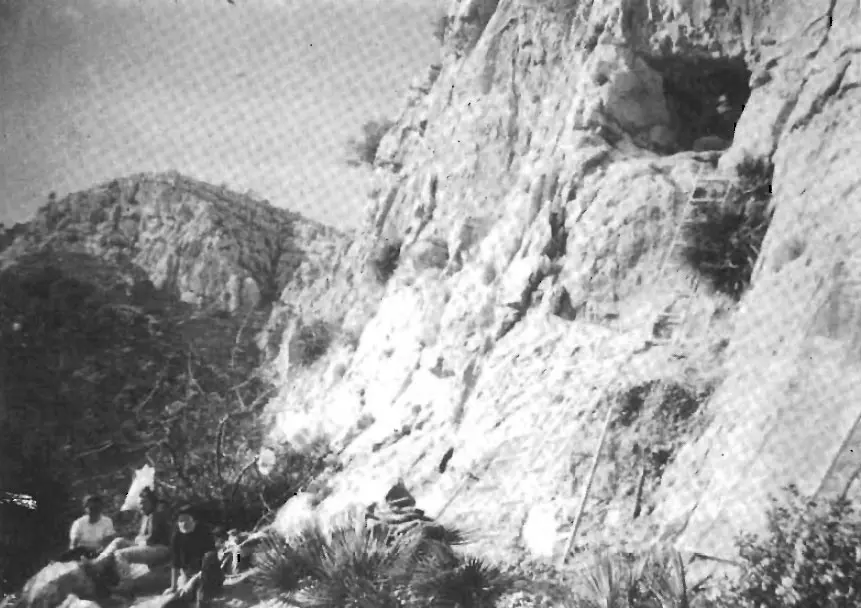
Entrance to the Cau d’en Borràs. Next to the steps, you can still see the last remnants of earth that had accumulated outside, originating from within the cave.
This is what the rock shelter-chasm looks like: a prehistoric hideaway inOropesa del Mar
The Cau d’en Borràs is not a traditional, large cave open to the landscape, but rather a combination of a rock shelter and a chasm-fissure, features typical of the karst terrain in which it is situated.
The entrance to Cau d’en Borràs is narrow and rectangular in shape, approximately 1.80 metres wide and 1.30 metres high.
A small passageway, some 5.5 metres long, leads to a vertical diaclase – that is, a deep fissure cutting into the rock.
This diaclasa is not merely a passage; it is a genuine natural shaft which, at the time of the excavation, reached a depth of at least 8 metres.
The upper opening of the chasm narrows as it descends, although it subsequently widens again, forming a unique and challenging underground space for explorers and archaeologists.
The fissure-chasm connected to the outside via a narrow vertical shaft, which is now almost completely blocked by natural debris.
This passage was probably the route by which sediments, animals and, on occasion, humans entered the cave over thousands of years.
The environment inside the cave was very special: the accumulation of sediments created a complex stratigraphy comprising up to 14 distinct levels, formed by layers of clay, gravel and oolitic breccia (rock mixed with fossil remains).
This sequence reflects thousands of years of natural history, during which various climatic and ecological events left their mark.
Furthermore, remains of broken stalagmites and calcareous concretions were found, indicating an active and humid underground environment at certain times, very different from the drier climate that characterises the region today.
In short, the Cau d’en Borràs was a perfect refuge: hidden, sheltered, difficult for large predators or enemies to access, and strategically located near water sources and with unobstructed views of the coastline.
These conditions explain why it was occasionally chosen by both wild animals and the earliest human groups passing through the region.
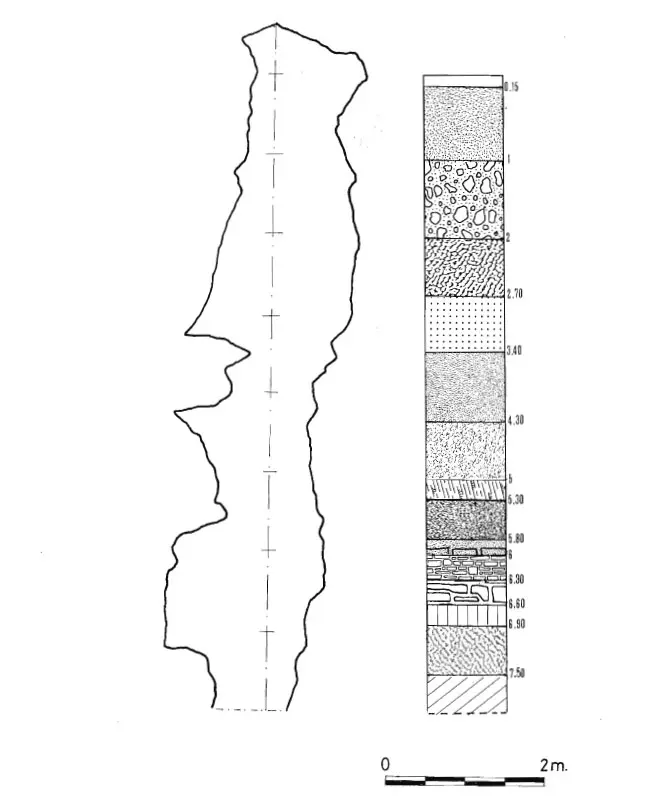
Figure 1 – Vertical section of the chasm-joint with the corresponding stratigraphic cross-section
Life hundreds of thousands of years ago: animal and human remains
Exploring the Cau d’en Borràs is like opening a window onto a lost world, where life was very different from today.
Thanks to the discoveries made by archaeologists and palaeontologists, we know that around 400,000 years ago, this cave was home to both wild animals and early humans.
The fossil remains recovered from the various layers of the site are impressive in both quantity and variety.
Among the most notable animals are large carnivores such as the lynx, the leopard, a small canid and a bear that may have belonged to the genus Plionarctos.
Bones of small mammals such as moles, mice (Apodemus sp. and Microtus sp.), rabbits, and numerous species of birds were also found, suggesting that the cave was a magnet for local wildlife.
But one of the most surprising discoveries was the identification of the remains of a very special animal: Hemitragus bonali, an extinct species of wild goat.
This is the first discovery of this species on the Iberian Peninsula. Hemitragus bonali inhabited mountainous areas with a temperate climate, and its presence helps to date the deepest layers of the site to the Middle Pleistocene.
As for human presence, the evidence is equally revealing.
Stone tools – cores, flakes and percussors – were found, belonging to an archaic culture, probably linked to the earliest Homo heidelbergensis or European archaic humans.
These artefacts were crafted in a very rudimentary manner, using pebbles collected from nearby beaches or local stones.
No sophisticated secondary flaking techniques are evident, suggesting that these were tools intended for immediate use, such as cutting meat or processing materials.
The type of human occupation revealed at Cau d’en Borràs was neither prolonged nor permanent. The narrowness of the chasm and its limited conditions suggest sporadic visits: small groups who, perhaps during hunting expeditions, took advantage of the shelter to take brief refuge, rest or process their prey.
In short, the Cau d’en Borràs is a setting that allows us to imagine a harsh and wild way of life, where every day was a struggle for survival in a still unspoilt natural environment.
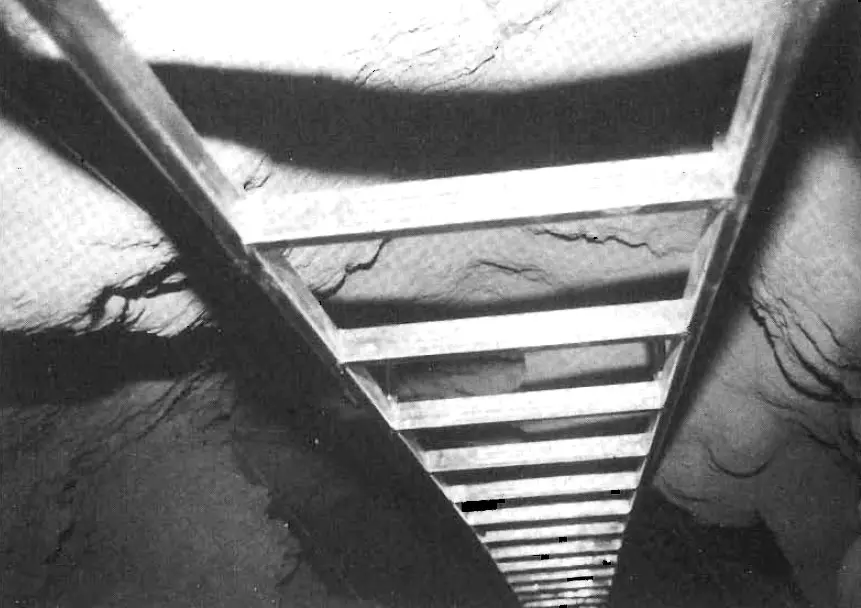
Partial view from the top of the chasm-fissure showing its vertical extent.
The archaeologists’ work: what was found and how it was studied
Following the initial discovery made by Vicente Borràs, the Provincial Archaeology Service organised its first scientific excavation campaign in 1979.
This involved leading experts such as Eudald Carbonell, Jordi Estévez and Francesc Gusi, alongside advice from the CSIC’s Institute of Quaternary Ecology in Barcelona.
The work at Cau d’en Borràs proved to be a real challenge. The archaeologists began by drawing up a detailed plan of the rock shelter, measuring each section and producing a precise stratigraphic section.
Fourteen different sedimentary layers were identified, alternating between clays, gravels and bone-rich breccias.
Each layer contained valuable evidence:
- Fossilised animal remains, such as the bones of carnivores, herbivores and birds.
- Stone tools, such as cores, hammerstones and flakes.
- Calcareous concretions and fragments of stalagmites, which provided clues about past climatic conditions.
A key part of the work involved the meticulous sifting of soil deposited both inside and outside the cave.
Thanks to this process, numerous microfossils and archaeological artefacts were recovered that would have gone unnoticed in a conventional excavation.
In addition, the remains were sent for specialist analysis:
- The animal fossils were studied at the CSIC’s Quaternary Laboratory.
- The lithic materials were classified and preserved at the Provincial Archaeology Service, and some were exhibited at the Provincial Museum of Castellón.
An interesting fact is that the team involved in the excavations included both professional archaeologists and enthusiastic volunteers, demonstrating that a passion for prehistory can mobilise an entire community.
Thanks to this effort, we now have an in-depth understanding not only of the material remains, but also of the ecological, climatic and cultural context of the prehistoric inhabitants of Oropesa del Mar.
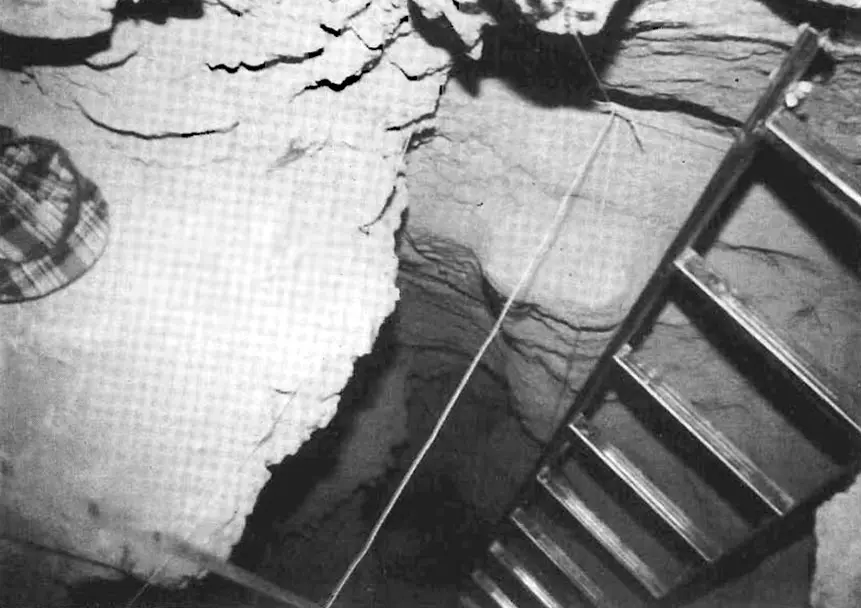
Partial view of levels 4 and 5 (2.70/4.30 m).
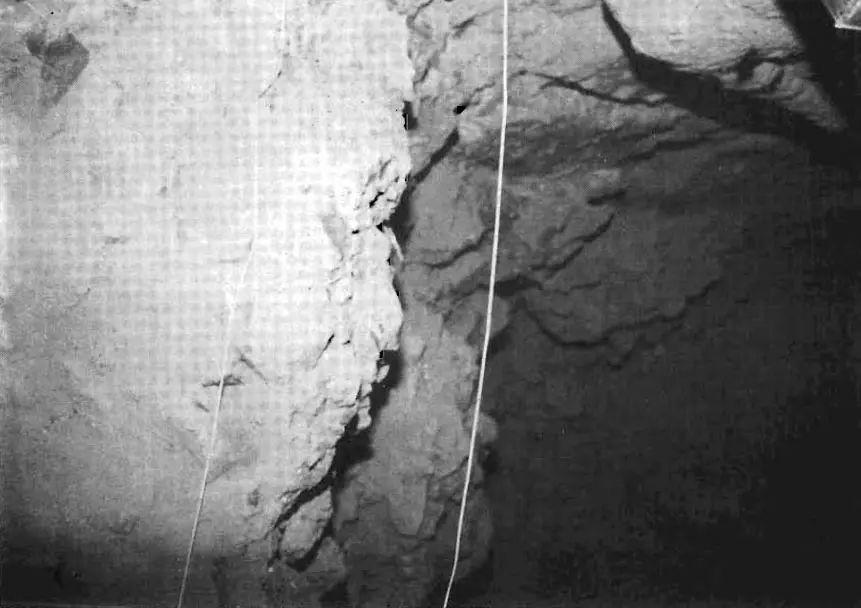
Provisional bottom of the pit showing levels 8 to 14 (5.30/8 m).
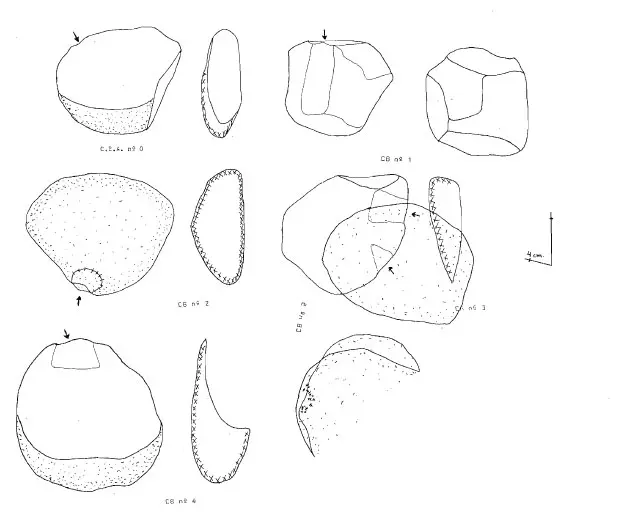
Image 2 – Chopper-type unifacial; 1. Core with a single flake removal; 2. Striker with a distal chip; 3. Chopper-type unifacial; 4. Cortical heel flake; 5. Striker with use-wear pitting
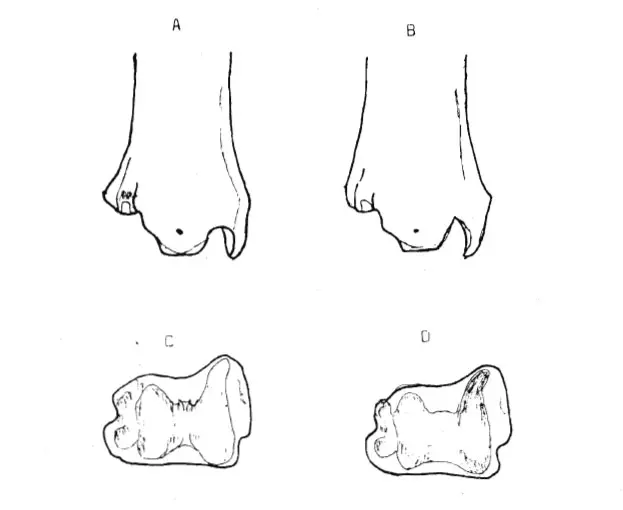
Figure 3 – A) Right distal tibia of Capra. B) Right distal tibia of Hemitragus. Viewed from the anterior side. C) Right tibia of Capra. D) Right tibia of Hemitragus. Viewed from the distal articular surface.
Curiosities from Cau d’en Borràs: surprising finds
Cau d’en Borràs is significant not only for its age, but also for several unique finds that have captured the attention of researchers.
These are some of the most fascinating discoveries to have emerged from this site:
Stone tools made from boulders
The humans who passed through Cau d’en Borràs did not use just any stone.
Many of the tools found were fashioned from pebbles collected from nearby beaches. These pebbles were then struck in a simple yet effective manner to create cutting tools, such as choppers — primitive single-edged axes.
This fact speaks to an intelligent adaptation to the environment: the earliest settlers made use of the most accessible natural resources for their daily lives.
No signs of fire or settled life
Unlike other sites such as L’Aragó or Lunnel Viel in France, no remains of fires or domestic structures have been found at Cau d’en Borràs.
This confirms that the site was used on an ad hoc basis rather than as a permanent settlement, making it ideal for hunters passing through or groups of gatherers.
Remains of an ‘unknown’ animal on the Iberian Peninsula
One of the greatest treasures discovered is, without doubt, the presence of remains of Hemitragus bonali, an extinct species of mountain goat that had never before been documented in Spain.
Until then, it had only been known from areas in France. This makes Cau d’en Borràs a key site for understanding the spread of species during the Middle Pleistocene.
Signs of sporadic human activity
The presence of stone tools alongside animal remains suggests that small groups of people used the cave as a temporary shelter. They did not live there continuously: it seems they would arrive, process their prey and then move on.
In fact, a complete animal spine was found in one of the deepest layers, probably discarded there after being butchered at the cave entrance.
Each of these details makes Cau d’en Borràs a veritable time capsule, a key piece in reconstructing the lives of our ancestors on the Mediterranean coast.
The significance of Cau d’en Borràs in Spain’s prehistoric history
Cau d’en Borràs occupies a special place on the archaeological map of the Iberian Peninsula.
Although it is less well known than major sites such as Atapuerca (Burgos) or Cueva Victoria (Murcia), its scientific value is unquestionable.
Firstly, it is one of the few direct accounts of human occupation on the Mediterranean coast during the Middle Pleistocene.
Whilst most major sites are found in the interior of the peninsula or are associated with permanent settlements, Cau d’en Borràs documents a more sporadic way of life, probably linked to groups of hunter-gatherers who explored the coastal mountain ranges.
Its geographical location — elevated, sheltered, overlooking the sea and close to water sources — fits perfectly with the settlement patterns used by humans of that period.
What makes Cau d’en Borràs unique?
- Unique fauna: The presence of Hemitragus bonali makes it a key site for studies on species dispersal during the Pleistocene.
- Archaic stone tool industry: The tools found bear witness to very rudimentary flaking techniques, typical of the earliest human cultures of the Lower Palaeolithic.
- European connections: It shares characteristics with French sites such as Lunnel Viel and L’Aragó, suggesting that there was cultural continuity across the western Mediterranean arc.
A missing link between the south and the north-east of the peninsula
Archaeologists have pointed out that Cau d’en Borràs is strategically situated between the major concentrations of prehistoric deposits in the south (such as El Aculadero, in Cádiz) and the north-east (such as Cau del Duc de Ullà, in Girona).
Studying it helps to complete the map of migration routes and human settlement in such ancient times.
How can you visit Oropesa del Mar and discover its incredible heritage?
Visiting Oropesa del Mar is about much more than just enjoying the sun and the beach. This corner of the province of Castellón hides real historical gems such as the Cau d’en Borràs, which perfectly complement any cultural or nature-based getaway.
Although the Cau d’en Borràs is not currently open to mass tourism (due to its location and protected status), simply knowing it exists adds a special value to a visit to Oropesa.
You can explore its natural surroundings via the walking trails that wind through the Sierra de Oropesa and the Barranco del Señor.
From the heights of these mountain ranges, you’ll enjoy breathtaking views of the sea and the rugged terrain that served as a refuge for our ancestors thousands of years ago.
Other must-see places in OOropesa del Mar:
- The old town: A labyrinth of medieval streets steeped in history and full of picturesque corners.
- Oropesa Castle: An 11th-century Moorish fortress, offering guided tours.
- The Torre del Rey: A 16th-century defensive tower overlooking the sea.
- The beaches: La Concha, Morro de Gos and Playa de la Renegà, perfect for unwinding after a cultural excursion.
- The Vía Verde del Mar: Ideal for exploring on foot or by bike, linking Oropesa with Benicàssim.
And if you’re a fan of archaeology or palaeontology, be sure to visit the Castellón Museum of Ethnology, where some of the artefacts found at Cau d’en Borràs are on display.
In short, Oropesa del Mar is the perfect place for those looking to combine nature, history and relaxation. The Cau d’en Borràs is a key chapter in this history hidden underground… and now on your itinerary too!
The archaeological site is well worth a visit, and there is plenty more to see in the surrounding area. The castle, the old town, the viewpoint and the beaches are all featured in the guide to Things to do in Oropesa del Mar.
References and acknowledgements
This article has been made possible thanks to the research carried out by leading archaeologists and palaeontologists such as Eudald Carbonell, Jordi Estévez, Francesc Gusi and Vicente Borràs, whose initial discovery opened a new window onto the past of Oropesa del Mar.
All the information presented here is based on rigorous scientific sources, in particular the official document for the excavation project:
Main reference:
Carbonell, E., Estévez, J., Gusi, F. (1979–1981). Preliminary results of the work carried out at the Middle Pleistocene site of ‘Cau d’en Borràs’ (Orpesa, Castellón). Jaume I University of Castellón.
We would like to thank all the institutions, researchers and collaborators who have enabled this fragment of human history to see the light of day once again.